
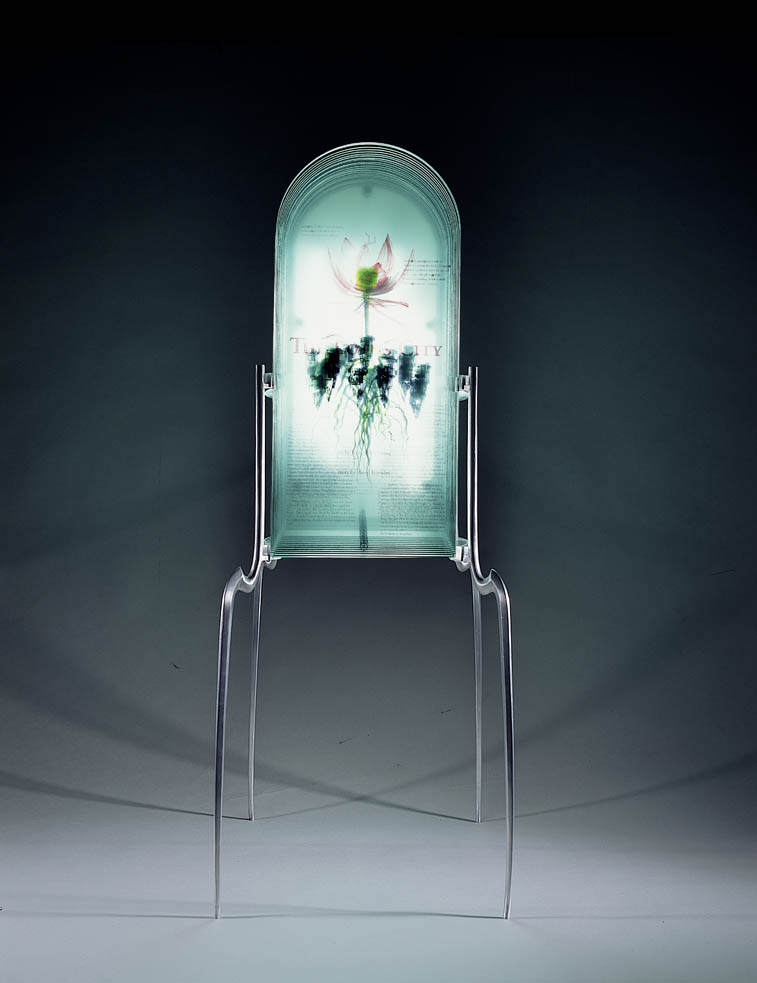
Acrylic plates, aluminum frame, light box
W30 x H70 x L40 cm
2005-04-01
Story
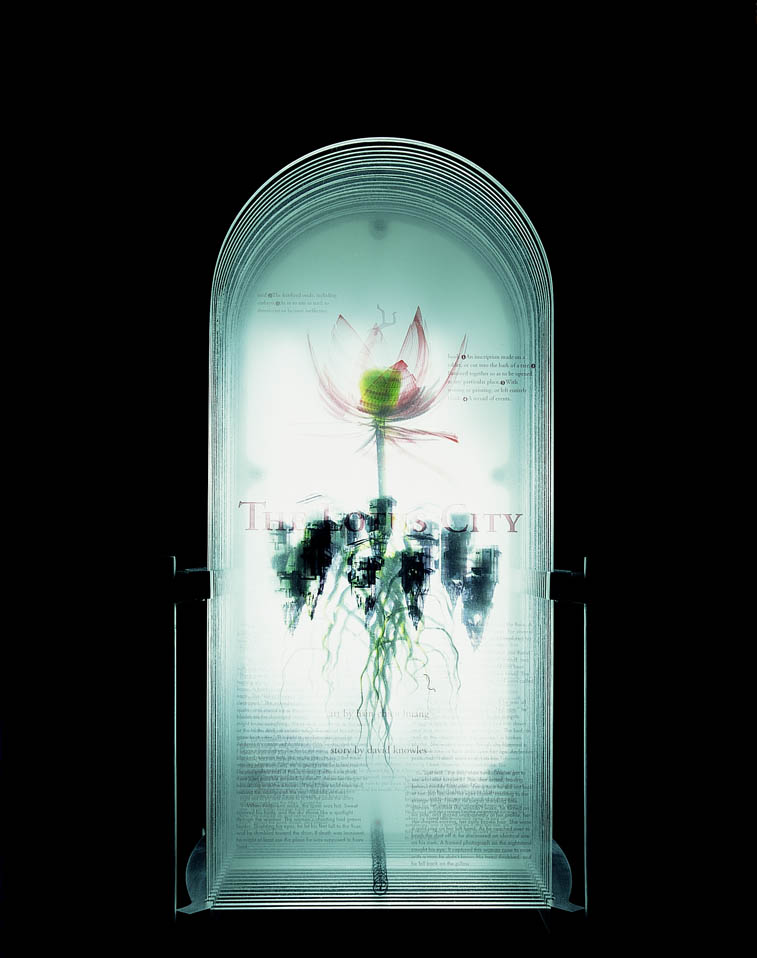
On day, I received a package. Inside the package was a strange artifact. It looked like a book, but also looked like a miniature specimen of a city. It was sealed in numerous slices of glasses. Some slices have text on them, and seem to be records about a city. I try to reconstruct what happened to the city from these fragmented words. Because the texts are so sketchy, we have to fill in the missing information with our imagination.
We can not tell you, whether this artifact shall be regarded as a creature's biological specimen whose name called "The Lotus City", or it shall belong to a city's field research in the discipline of social science. Nevertheless, in Taipei city's raining season, I often sit by the window, study the wind-dry city specimen, and imagine what it would like when it was alive.
The Specimen of Memory
I began this form of creation since the end of 2004. I called it "The Specimen of Memory".
The sources of these specimens came from my memory, I present them with sliced sections. They are sculptures with the form of books, each book is displayed on a bookstand, and each acrylic page is printed with graphics. The graphics are surreal images created by computer, printed on glass or acrylic plates, they look exactly like specimens. I am intrigued by this form because it is a readable space constructed by stacking up words. From different angles the audience find different texts. Thus different meanings are generated as one takes different angles.


Stories and Performance in Sculpture
The text below is written by David Knowles, it had been showed with the "Specimen of Memory" during the opening in the Hong Gah Museum.
An Investigating Briefing of the Disasters in Wanfang Flower Market
Thank you for attending this meeting. The tragedy happened on 19th June has been highly concerned by the public; unfortunately, after two weeks the facts of the tragedy still haven't cleared. There are all kinds of assumptions, from scientific to religious points of view, some are quite superstitious.
Fifteen houses had been destroyed, nineteen apartment buildings disappears. Hitherto 1,136 people died, 55 missing, and over the past several days we found the human remains in ruins, some of them were dropped from air. What on earth had happened at 4:20 am, June 19th in the Wanfang Flower Market? I think not only people here today but also all Taipei people, even people all over Taiwan are very concerned. Nevertheless, no one had provided any convincing explanation so far.
The video I am playing now must have been viewed many times by all of you. It is all we know about the incident: a huge object rose from the ground of the Wanfang Flower Market, but no one knows what it was.
New evidence might help us reveal the truth of this horrible incident. Here I briefly explain where it is from: about one week ago, a package was dropped from air to the place about two hundred meters from the location of the incident. Inside the package we found an odd object, it looked like a book, it also looked like a specimen- a specimen of a city. The city model was cut into layers of sections and sealed in glass plates. My assistant is presenting it for everybody to check out.
As you all can see, there are texts on these glass plates. They seem to be someone's journal about how the huge object was brought up to the sky. We have investigated who the author is and realized it is Mr. Ching-Wei Yang, a botanist working for the Flower Market. Here we reveal the content of the journal; hopefully it will help us understand what had happened.
Page 8
He woke up face down on the cool tile floor. A coffee cup lay in shards before his eyes. For several minutes he didn't move, then he gently explored his bloodied temple with his fingertips. "Mr. Andenken?" a voice called. "Hello? Are you there?" Their hands, knees and shirts covered in mud, two men stepped into the kitchen. The bald one bent down on one knee and offered a damp towel. The other kept going through the house, and soon called back, "She's here, alive."
The bald man asked Andenken if he was all right, if he thought he could sit up. "Not now," he replied. The strangers lifted him by his armpits, dragged him to the bedroom, and laid him down next to a woman he did not recognize. The bed, as well as the woman in it, was covered in broken plaster. She wasn't awake, though she hummed a repetitive tune, a faint smile upon her lips. Andenken protested. "I don't want to disturb her."
"Just rest," the bald man said, "We've got to see who else survived." The men exited, leaving behind muddy footprints. For a time he did not look at her. Just lay with his eyes closed, listening to the strange song. Finally, he began sneaking little glances. Satisfied she wouldn't wake, he turned on his side, and gazed unabashedly at her profile, her star-shaped earring, her curly brown hair. She wore a gold ring on her left hand. As he reached over to brush the dust off it, he discovered an identical one on his own. A framed photograph on the nightstand caught his eye. It captured this woman nose to nose with a man he didn't know. His head throbbed, and he fell back on the pillow.
Page 14
Later that evening, the bald neighbor returned with a burlap sack of oranges and a lit candle stuck in an empty wine bottle. Wincing, Andenken sat up to greet him. "Please," he asked, "what has happened here?"
The bald man handed him an orange, and squinted with one eye, like a man looking through a telescope. "There was the sound first. Loud cracking, or crashing, a tearing almost. Then the ground just fell away. I don't know. A trunk, huge, must have exploded through the earth. The Hall of Flowers, Mr. Andenken, I'm sorry. It's destroyed." The wounded man lay back as the other spoke, and stared up at the quivering shadow of the fan blades on the damaged ceiling. "We were hoping you might know something. We're stuck somehow, to the sprout or the roots. And we're still rising. The rest of the city is gone from view." The bald man's face darkened at Andenken's continued confusion. "We've decided to jump. I suggest you and your wife do the same. Your sheets, blankets, we can help you make parachutes." But there was no response. "Sir, we're going now, in a few minutes. Do you understand? If this is heading where we think, there's no possible survival, is there?" Andenken began to hum along with the woman. "I tried," the bald man said, leaving the oranges on the rug. "Good-bye then."
When Andenken woke, the room was hot. Sweat covered his body, and the sky shone like a spotlight through the window. The woman's chanting had grown louder. Shielding his eyes, he let his feet fall to the floor, and he stumbled toward the door. If death was imminent, he might at least see the place he was supposed to have lived.
Page 18
On hands and knees, he climbed his way along the network of branches that led from house to house, doing his best to ignore the dark abyss below. Unable to raise his eyes to the terrible brightness overhead, he kept his squinting focus on the mud-caked organic life form beneath him. The remaining two and three story houses were abandoned. Pairs of shoes waited outside of open doors, plates with unfinished meals still lay upon dinner tables. Almost immediately, he became overwhelmed by it all, and decided to make his retreat.
Back in his bedroom, he contemplated a shelf full of unfamiliar books on horticulture, and felt hopeless, unmoored, exhausted. Once he returned to bed, however, his spirits lifted. The proximity to this woman who he must have loved comforted him. How he adored the sound of her voice! On his own nightstand, he found a book whose black cover was blank. He opened it and read the name the bald man had called him. Still, several pages passed before he realized it was his own diary.
Page 20
The excavation of his old life brought about the following insight: After only three years, his once vibrant marriage had turned stale. Olivia (the humming woman) had miscarried twice, and had begun fertilization treatments. He loathed his lackadaisical co-workers at the Hall of Flowers, and, finally, he had still not been paid the proper amount of royalties for his book. There seemed to be nothing happy or interesting about his old life, and this reassured him. He ‘d been right not to try and return to it. He set aside the diary and took a nap.
The light was so glaring when he woke up that he couldn't stand to read for more than a few sentences at a time. His wife's humming, too, had grown louder. They must be linked somehow, the brightness and her volume. He reached over and stroked her soft cheek, then was struck with an idea. He turned and dug around in the nightstand drawer where he found two invaluable items: a pair of sunglasses, and a pen. Before it was too late, he told himself. Then he put on the glasses and flipped to a blank page.
Page 22
It went much better than he feared. The events of the past day made the leap to the diary without apparent difficulty. He read it back aloud, confident that he had portrayed it all as it had actually happened, then again, how would he know otherwise? But even if he hadn't, he consoled himself with the thought that at the very least, by unburdening his thoughts onto the pages, he had seized upon the one small bit of continuity with his former self that was available.
All the while, the shoot continued its ascension. At night, when the temperature dipped to a more comfortable level, Olivia quieted down, but he could still sense the locomotion, the surge. The curtains never stopped dancing, disturbed by a steady wind. He put his hand on the woman's. Then looked toward the bookshelf across the room. The volume's spines reminded him of a city skyline, but what city he couldn't say. He could scarcely make out the titles. Except for one, in an oddly familiar bold yellow type. He jumped up and ran across the room, pulled the book down, and began scouring its contents.
Page 24
It was still dark outside when the room began to shake. The headboard pounded the wall, and the ceiling fan fell with a clump of plaster, smashing on the hardwood floor. Andenken clung to the mattress and gritted his teeth. His wife was humming at an unbearable volume. Books toppled from the shelves, glass was breaking all around him. He reached for the diary on the nightstand, fell out of bed, landing on his knees, and crawled down the hallway, toward the door. Outside, the houses on either side of his own were swaying and bouncing like drunken marionettes. The root system was alive, and he kept losing his grip, yet he inched forward until he had come to the place where the Hall of Flowers once stood. He wanted to write it down as it happened. Record the great event, but just as he was settling down, removing the pen from his back pocket, the sun suddenly overtook the horizon. Reflexively, he glanced up at it. Closer and brighter than seemed possible, it immediately blinded him. The last image he experienced, burned into his cornea, was the outline of the giant lotus bud. The noise kept building, and he tried in vain to put down a few blind words, but by now the atmosphere was in flux, and he could no longer find his breath. Finally, the sky roared one last time, knocking him free of the root, his city, and his world.
Page 30 from Andenken's Illustrated Encyclopedia of Botany
Ló-tus: Numerous mystical and symbolic references to this plant can be found throughout world history. 1. Ancient Egyptians: Before the universe was created there was only vast ocean. One day, a lotus blossom broke the plane of the water, opened, and gave birth the sun god, Atum. It is also believed that the flower's petals, when placed in the mouth of a dying animal, help ease the spirit out of the body. 2. The Greeks: The fruit of this tree induces amnesia, making men forsake their home country to live forever in ‘Lotus Land.' 3. Hindu religion: In the Hindu faith, the life of the lotus plant is considered to mimic that of man. Just as its sprout shoots upward through the darkness to reach the sun, so too does man, born ignorant, strive his whole life to attain enlightenment. Further it said that the wife of a couple who ingests the lotus seed can expect a child the following season.
The Lotus acts as a filter for the water in which it grows. The seed takes root at the bottom of fecund swamps, cloudy ponds and slow-moving rivers. Over time, as it comes to maturity, it renders the opaque water transparent. Many believe that the murkier the water in which the lotus is born, the more beautiful the flower it produces.
The video preview for the exhibition
©︁黃心健